Terraforming Mars Board Game Review

Terraforming Mars
My wife and I have played Terraforming Mars 75 times now, and I can say this without hesitation: it is one of the best games we own. After that many plays, most games would have worn out their welcome. This one has not. It still comes off the shelf on a regular basis, and we still look forward to every session.
For anyone who has not played it, Terraforming Mars is an engine-building strategy game designed by Jacob Fryxelius, published by FryxGames, and brought to North America by Stronghold Games. You and your opponents take on the roles of competing corporations working to make Mars habitable. Over the course of the game, you raise the temperature, increase the oxygen level, and add oceans until the planet can support life. It plays 1 to 5 players and, according to BoardGameGeek and Stronghold, runs about 90 to 120 minutes. For us, a full two-player game usually takes around three hours, and we are perfectly happy spending the afternoon on it.
The heart of the game is the project cards. There are over two hundred of them; you buy them into your hand, then play the ones that fit your plan. Some give you a one-time boost, some give you an ongoing action, and many build on each other in ways you do not see coming until the right pieces line up. You manage six resources — MegaCredits, steel, titanium, plants, energy, and heat — and the real satisfaction comes from turning a slow, sputtering start into a machine that practically runs itself by the back half of the game.
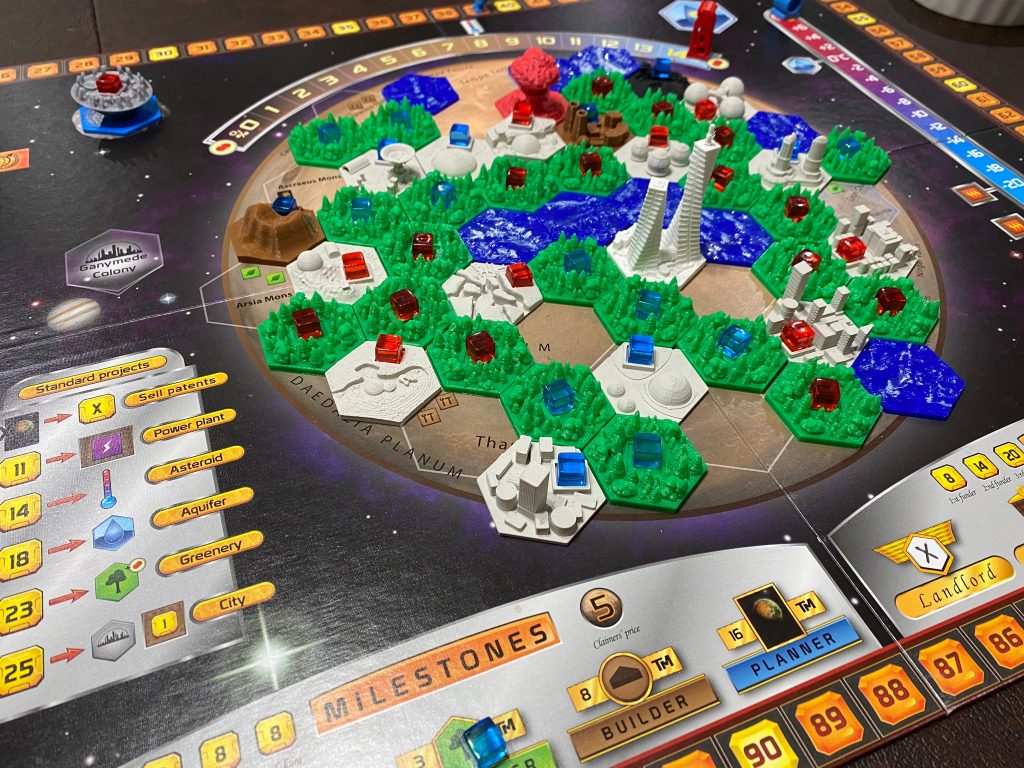
Everything ties back to your Terraform Rating. Every time you raise one of the three global parameters, your rating goes up, which increases both your income and your final score. The board itself tracks temperature, oxygen, and the generations as they pass, and you place city, greenery, and ocean tiles directly onto the map of Mars. There are milestones to claim and awards to fund, and those add another layer of competition on top of everything else. It is a lot to think about, but it never feels like busywork. Every decision matters.
What keeps us coming back after 75 games is that no two plays are ever the same. The cards you draw, the corporation you start with, and the order things come out in all push you toward a different strategy every time. One game you are leaning on heat and temperature, the next you are flooding the board with greenery, and the next you are chasing science cards and ignoring the map almost entirely. That variety is the reason this game has stayed in our rotation for as long as it has.
We also own all of the expansions, and they each add something worthwhile. Prelude speeds up that slow opening and gets the engine humming faster. Venus Next opens up a whole second planet to work on. Hellas and Elysium give you alternate boards with new milestones and awards. Colonies and Turmoil add more player interaction and a bit more chaos. The nice part is that you can mix and match them however you like, so you can keep the game light or pile everything on for a longer, deeper session.
I should admit just how much we love this game, because we do not own just one copy. We have a dedicated travel version that comes with us on vacation. We take a lot of cruises and set up in the promenade on a sea day or two, depending on the length of the cruise and how many sea days there are. In fact, we take several games with us. We also have a pimped-out version at home with 3D-printed components, and the upgraded tiles and resource markers make an already great game look and feel that much better on the table.
If there is a downside, it is the same one that comes with most big strategy games. It takes time, it takes table space, and the first play or two can feel overwhelming while you are still learning what all the icons and cards do. This is not the game you pull out when you have twenty minutes to kill. But once it clicks, the length is part of the appeal, not a problem.
For couples, families, or any group that enjoys deep strategy and a satisfying build, Terraforming Mars is absolutely worth owning. Seventy-five plays in, it has more than earned its place as one of our all-time favorites, and I do not see us slowing down any time soon.